Let us shut our eyes and talk about the weather…

Image Source: Creative Commons: unsplash.com

Once upon a time there was a Weatherman. He was a friendly fellow, unimposing but trustworthy. People listened to his words with respect and planned their future accordingly.

Like warmth in winter or a cool breeze in summer he was always a welcome part of any day. His persona reached out to people as part of a traditional way of life. His was a trusted voice of the seasons.

Then suddenly things changed. In the twinkling of a bloodshot eye this scion of a reputable family all at once lost his reputation. He became a blackguard, a villain, a malefactor, a gangster without a gun. 

With frightening speed respect turned into disdain. Savage words molested him.

Lies were said to leave his mouth like fleas in a medieval plague. His judgement was seen as contaminated by myth and non sequiturs. He was anti social, confirmed by the masses as a destroyer of jobs.

Who were the Weatherman’s assassins?

You may be wondering about the precise causes of this sweeping change in the Weatherman’s destiny. Well, that change has a lot to do with shadowy forces dedicated to maligning science. Look – I’ll show you.

They cooked the science to make this thing look as if the science was settled, when all the time of course we knew it was not.

United States Senator Jim Inhoffe,

I’ve instinctively known this from the get-go, from 20 years ago! The whole thing is made up, and the reason I know it is because liberals are behind it! When they’re pushing something, folks, it’s always bogus. 

Rush Hudson Limbaugh

Ah the poor Weatherman! Such a dutiful soul he was. Intent on service. Careful in his ways. Meticulous. Always pleased to be an active source of information. 

How sad the tempest of scorn has made him! Self harm is in his mind. Reputations can be so vulnerable, especially when they interfere with large scale business planning. Words can be takeover bids. Here are some more examples.

Nobody can argue that there isn’t climate change. The climate’s been changing since time immemorial.

Do I believe there is global warming? No, I believe it’s all a load of bullshit. But it’s amazing the way the whole fucking eco-warriors and the media have changed. It used to be global warming, but now, when global temperatures haven’t risen in the past 12 years, they say ‘climate change’.

Well, hang on, we’ve had an ice age. We’ve also had a couple of very hot spells during the Middle Ages, so nobody can deny climate change. But there’s absolutely no link between man-made carbon, which contributes less than 2% of total carbon emissions [and climate change].

Michael O’Leary, Boss of Ryanair in 2010

“Listen to me,” says another seer with language queer, “climate change science is absolute crap.”

Reference: https://www.abc.net.au/news/2017-10-10/tony-abbott-climate-claims-dont-add-up/9034204 9/10/19

Another dignitary flaunts a lump of coal didactically in a very public place – a devious alliance.

Image Source: https://10daily.com.au/news/politics/a180903atv/scott-morrison-on-that-time-he-carted-coal-into-parliament-20180903 22/10/19

Then there is a voice from on high – very high – piercing the air with such nonsense a brain seems missing:

I believe that there’s a change in weather, and I think it changes both ways…Don’t forget it used to be called global warming. That wasn’t working. Then it was called climate change. Now it’s actually called extreme weather, because with extreme weather, you can’t miss.

No need to write the name

History is not spared by some as a tool of scepticism.

Carbon pricing harkens back to the idea, you know, that Massachusetts had to deal with, the witchcraft trials. The idea that witches change the weather. Now they’re claiming SUVs and our coal plants are changing the weather

Marc Morano

Source: https://www.desmogblog.com/marc-morano 22/10/19

The efficient market hypothesis underlies much climate scepticism.

When economies get richer they not only make people wealthier, they generally provide immense environmental benefits. And so if you actually believe, if someone actually believes that global warming is a crisis that must be addressed…I think it would be much better to free up the economy and get rid of the EPA rules and a lot of the Department of Energy programs and let the economy boom forward.

Myron Ebell

Source: https://www.businessinsider.com.au/trump-epa-climate-science-myron-ebell-2016-11?r=US&IR=T 22/10/19

What are these people whose words I quote, these sellers of doubt?

Why, they are intruders consciously maligning reality with a purpose. They have a mission statement to retain and promote destructive, established industries.. They tempt lawmakers with the profits from self interest.

What do they do to me?

They shake me. They conjure outbursts from me. They revive words I have found in my past, and they cause me to implode mentally.

Like this, with George Orwell and 1984:

The heresy of heresies was common sense.

war is peace

freedom is slavery

ignorance is strength

It was a bright cold day in April, and the clocks were striking thirteen.

They re-link me to the Worldly Goods of the Everyman I once studied at university …

Everyman: Yet in my mind a thing there is;

All my life I have loved riches;

If that my good now help me might,

He would make my heart full light.

I will speak to him in this distress. –

Where art thou, my Goods and riches?

Goods:  Who calleth me? Everyman? What hast thou hast!

I lie here in corners, trussed and piled so high,

And in chest I am locked so fast,

Also sacked in bags, thou mayst see with thine eye,

I cannot stir; in packs low I lie.

What would ye have, lightly me say?

Everyman: Come hither, Goods, in all the hast thou may,

For of counsel I must desire thee.

Goods: Sir, and ye in the world have trouble or adversity,

That can I help you to remedy shortly.

Everyman: It is another disease that grieveth me;

In this world it is not, I tell thee so.

I am sent for another way to go,

To give a straight account general

Before the highest Jupiter of all;

And all my life I have had joy and pleasure in thee.

Therefore I pray thee go with me,

For, peradventure, thou mayst before God Almighty

My reckoning help to clean and purify;

For it is said ever among,

That money maketh all right that is wrong.

Goods: Nay, Everyman, I sing another song,

I follow no man in such voyages;

For and I went with thee

Thou shouldst fare much the worse for me;

For because on me thou did set thy hand,

Thy reckoning I have made blotted and blind,

That thine account thou cannot make truly;

And that hast thou for the love of me.

Everyman: That would grieve me full sore,

When I should come to that fearful answer.

Up, let us go thither together.

Goods: Nay, not so, I am, to brittle, I may not endure;

I will follow no man one foot, be ye sure.

Everyman: Alas, I have thee loved, and had great pleasure

All my life-days on good and treasure.

Goods: That is to thy damnation without lesing,

For my love is contrary to the love everlasting.

But if thou had loved moderately during,

As, to the poor give part of me,

Then shouldst thou not in this dolour be,

Nor in this great sorrow care.

Everyman: Lo, now was I deceived or was I ware,

And all may wyte* my spending time. *blame

Goods: What, weenest thou that I am thine?

Everyman: I had wend so.

Goods: Nay, Everyman, say no;

As for a while I was lent thee,

A season thou hast had me in prosperity;

My condition is man’s soul to kill;

If I save one, a thousand I do spill;

Weenest thou that I will follow thee?

Nay, from this world, not verrily.

Everyman: I had wend otherwise.

Goods: Therefore to thy soul Good is a thief;

For when thou art dead, this is my guise

Another to deceive in the same wise

As I have done thee, and all to his soul’s reprief.

Everyman: O false Good, cursed thou be!

Thou traitor to God, that hast deceived me,

And caught me in thy snare.

Goods: Marry, thou brought thyself in care,

Whereof I am glad,

I must needs laugh, I cannot be sad.

Everyman: Ah, Good, thou hast had long my heartly love;

I gave thee that which should be the Lord’s above.

But wilt thou not go with me in deed?

I pray thee truth to say.

Goods:  No, so God me speed,

Therefore farewell, and have good day.

Do you get what I mean? The speakers I criticise, like Everyman, are obsessed with worldly goods! We must not let crass loyalty to what we own destroy the world.

The effect on me of those climate deniers is cataclysmic. So the brilliant Edgar Allan Poe’s words come back and haunt me thus…

From that chamber, and from that mansion, I fled aghast. The storm was still abroad in all its wrath as I found myself crossing the old causeway. Suddenly there shot along the path a wild light, and I turned to see whence a gleam so unusual could have issued; for the vast house and its shadows were alone behind me. The radiance was that of the full, setting, and blood-red moon which now shone vividly through that once barely-discernible fissure of which I have before spoken as extending from the roof of the building, in a zig-zag direction, to the base. While I gazed, this fissure rapidly widened –there came a fierce breath of the whirlwind –the entire orb of the satellite burst at once upon my sight –my brain reeled as I saw the mighty walls rushing asunder –there was a long tumultuous shouting sound like the voice of a thousand waters –and the deep and dank tarn at my feet closed sullenly and silently over the fragments of the “HOUSE OF USHER.”

The sceptics can also make me visit Creative Commons…

Source: Creative Commons https://glacierhub.org/author/kristin-hogue/ 18/10/19

Or cause me to seek out better opinions…

The Margaret Thatcher speech at the Second World Climate Conference on Tuesday November 6, 1990 comes to mind here. It is a view so nobly different from her later stand. No iron from her. Maybe irony.

But the threat to our world comes not only from tyrants and their tanks. It can be more insidious though less visible. The danger of global warming is as yet unseen, but real enough for us to make changes and sacrifices, so that we do not live at the expense of future generations.

Our ability to come together to stop or limit damage to the world’s environment will be perhaps the greatest test of how far we can act as a world community. No-one should under-estimate the imagination that will be required, nor the scientific effort, nor the unprecedented co-operation we shall have to show. We shall need statesmanship of a rare order. It’s because we know that, that we are here today.

[MAN AND NATURE: OUT OF BALANCE]

For two centuries, since the Age of the Enlightenment, we assumed that whatever the advance of science, whatever the economic development, whatever the increase in human numbers, the world would go on much the same. That was progress. And that was what we wanted.

Now we know that this is no longer true.

We have become more and more aware of the growing imbalance between our species and other species, between population and resources, between humankind and the natural order of which we are part.

In recent years, we have been playing with the conditions of the life we know on the surface of our planet. We have cared too little for our seas, our forests and our land. We have treated the air and the oceans like a dustbin. We have come to realise that man’s activities and numbers threaten to upset the biological balance which we have taken for granted and on which human life depends.

We must remember our duty to Nature before it is too late. That duty is constant. It is never completed. It lives on as we breathe. It endures as we eat and sleep, work and rest, as we are born and as we pass away. The duty to Nature will remain long after our own endeavours have brought peace to the Middle East. It will weigh on our shoulders for as long as we wish to dwell on a living and thriving planet, and hand it on to our children and theirs. 

Source: https://www.margaretthatcher.org/document/108237 9/10/19

Now here is Margaret Thatcher with a different voice:

So in a speech to scientists in 1990 I observed: whatever international action we agree upon to deal with environmental problems, we must enable all our economies to grow and develop because without growth you cannot generate the wealth required to pay for the protection of the environment.

Wow! What a reversal by the Baroness. Why was this so?

Consequences?

Source: Creative Commons https://glacierhub.org/author/kristin-hogue/ 18/10/19

Forgive my ramblings though if you don’t stand for something, you’ll fall for anything. But to end, I must try to be compos mentis.

Here’s To The Weatherman

Poor lad. The jumbo jet pilot trusts him with his life. The coal baron mangles him with contempt.

Closing Words

An unbelieved truth can hurt a man much more than a lie. It takes great courage to back truth unacceptable to our times. There’s a punishment for it, and it’s usually crucifixion. 

John Steinbeck, East of Eden

As to the weather – just relax. Everything’s fine.

Image: Creative Commons Jeff Atwood June 4, 2009

royciebaby

Some Lessons From History

Image Source: Creative Commons: https://www.imoa.ph/event-archive/

All Hail To The Expert!

What must I think in the face of life’s daily challenges?

What is my acceptable course to follow in times of stress?

Why, just listen to an expert stupid. A nice accredited answer this,  you might say. The final solution to the thought processes of the common man (and woman ✓).

When in doubt, call an expert. That is the spirit of the modern age. When not in doubt, call two experts.

PLEASE NOTE:

This post seeks to draw attention to false experts. It is a warning about unjustified status. It is a cry of despair related to undeserved attention given in so many examples from history.

But the true expert, the qualified voice of logic and reason, we must foster with all our energy.

Now who are these UNVERIFIED experts? Where can you find them?

No problem. They will emerge from your woodwork wherever you turn.

You will find they proclaim themselves energetically. There will generally be a verbal signal in their titles that advertises their “virtue”: words such as noted, respected, qualified, experienced, professional, distinguished, famous, prominent, renowned, eminent, celebrated, illustrious, legendary, lionised or latest will hoodwink you constantly.

They are not the gifts of true science which we must foster and protect with all our energy. Theirs is not rigorous, verifiable discourse.

Let us look at history to develop this point further. Have you noticed how big mistakes litter the pathways of human progress? Inelegant disasters are all too common. A few random samples will serve to clarify this.

My Examples

The Great Fire Of London

The Love Of Lead

The Great Depression

Two World Wars

The Vietnam War

The Cold War

The Iraq War of 2003 et seq.

Global Warming

Now on with the analysis. Not mere description but hard core analysis.

The Great Fire Of London: 1666

Here is one expert’s opinion.

For a man’s house is his castle, et domus sua cuique est tutissimum refugium [and each man’s home is his safest refuge].

Sir Edward Coke (pronounced Cook), in The Institutes of the Laws of England, 1628. 

Source: https://www.phrases.org.uk/meanings/an-englishmans-home-is-his-castle.html  10/10/19

This expert was right sometimes, but not in the great fire of 1666.

Now how’s this for poor advice from another expert?

Words of Sir Thomas Bloodworth, Lord Mayor of London, before the great fire got under way: “Pish! A woman could piss it out.” 

Here are more details of the burning.

Pepys Diary Entry, September 2 1666

By and by Jane comes and tells me that she hears that above 300 houses have been burned down tonight by the fire we saw, and that it is now burning down all Fish Street, by London Bridge. So I made myself ready presently, and walked to the Tower; and there got up upon one of the high places . . . and there I did see the houses at the end of the bridge all on fire, and an infinite great fire on this and the other side of the bridge . . .

So down [I went], with my heart full of trouble, to the Lieutenant of the Tower, who tells me that it began this morning in the King’s baker’s house in Pudding Lane, and that it hath burned St. Magnus’s Church and most part of Fish Street already. So I rode down to the waterside . . . and there saw a lamentable fire. . . . Everybody endeavouring to remove their goods, and flinging into the river or bringing them into lighters that lay off; poor people staying in their houses as long as till the very fire touched them, and then running into boats, or clambering from one pair of stairs by the waterside to another. And among other things, the poor pigeons, I perceive, were loth to leave their houses, but hovered about the windows and balconies, till they some of them burned their wings and fell down.

Having stayed, and in an hour’s time seen the fire rage every way, and nobody to my sight endeavouring to quench it . . . I [went next] to Whitehall (with a gentleman with me, who desired to go off from the Tower to see the fire in my boat); and there up to the King’s closet in the Chapel, where people came about me, and I did give them an account [that]dismayed them all, and the word was carried into the King. so I was called for, and did tell the King and Duke of York what I saw; and that unless His Majesty did command houses to be pulled down, nothing could stop the fire. They seemed much troubled, and the King commanded me to go to my Lord Mayor from him, and command him to spare no houses. . . .

[I hurried] to [St.] Paul’s; and there walked along Watling Street, as well as I could, every creature coming away laden with goods to save and, here and there, sick people carried away in beds. Extraordinary goods carried in carts and on backs. At last [I] met my Lord Mayor in Cannon Street, like a man spent, with a [handkerchief] about his neck. To the King’s message he cried, like a fainting woman, ‘Lord, what can I do? I am spent: people will not obey me. I have been pulling down houses, but the fire overtakes us faster than we can do it.’ . . . So he left me, and I him, and walked home; seeing people all distracted, and no manner of means used to quench the fire.

The houses, too, so very thick thereabouts, and full of matter for burning, as pitch and tar, in Thames Street; and warehouses of oil and wines and brandy and other things.

Source: http://www.pepys.info/fire.html 10/10/19

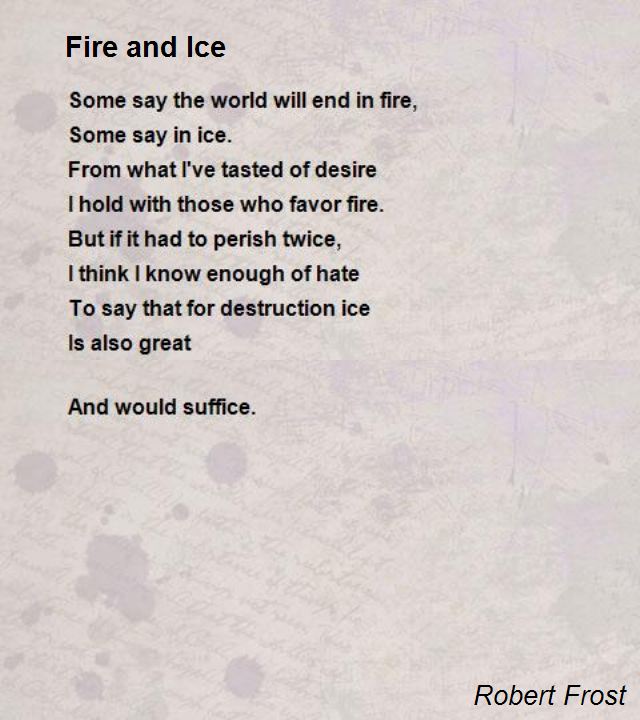
This poetic expert is closer to the truth today:

Source: https://me.me/i/fire-and-ice-some-say-the-world-will-end-in-c4a7bc8515e2437a85ad291fa49dbdf5 14/10/19

The Love Of Lead

Here is some more advice from the past.

Lead has been known to us humans for thousands of years. It has a low melting point and has thus been easy to separate from its bedrock. The Romans after their invasion of England were responsible for the wide dispersal of lead throughout their vast empire. This is probably why many Roman aristocrats suffered from lead poisoning.

What about this quote for misguided lead glorification ?

Ezekiel 27:12

Tarshish was thy merchant by reason of the multitude of all kind of riches; with silver, iron, tin, and lead, they traded in thy fairs.

Thus spake authority, flawed expert on wealth in praise of lead.

Here are some more details of the big mistake. Many past people were so sure of things.

Lead was a popular, valued, intricate part of life for millennia. It has had many uses ranging from bullets to water works. The first plumbers got their name from the Roman word for lead: plumbum. One of the biggest mistakes was linked to its sweet taste. Many drinks in ignorant times were flavoured with it. Poisonous outcomes. Experts of the formative past knew nothing of lead’s dangers. Time in the end did tell.

The Great Depression

Now this piece of expertise ranks very highly in the history of misguided advice.

1932 PRESIDENTIAL ADDRESS

There are three definite directions in which action by the Government at once can contribute to strengthen further the forces of recovery by strengthening of confidence. They are the necessary foundations to any other action, and their accomplishment would at once promote employment and increase prices.

The first of these directions of action is the continuing reduction of all Government expenditures, whether national, State, or local. The difficulties of the country demand undiminished efforts toward economy in government in every direction. Embraced in this problem is the unquestioned balancing of the Federal Budget. That is the first necessity of national stability and is the foundation of further recovery. It must be balanced in an absolutely safe and sure manner if full confidence is to be inspired.

The second direction for action is the complete reorganisation at once of our banking system. The shocks to our economic life have undoubtedly been multiplied by the weakness of this system, and until they are remedied recovery will be greatly hampered.

The third direction for immediate action is vigorous and whole souled cooperation with other governments in the economic field. That our major difficulties find their origins in the economic weakness of foreign nations requires no demonstration. The first need to-day is strengthening of commodity prices. That can not be permanently accomplished by artificialities. It must be accomplished by expansion in consumption of goods through the return of stability and confidence in the world at large and that in turn can not be fully accomplished without cooperation with other nations.

BALANCING THE BUDGET

I shall in due course present the Executive Budget to the Congress. It will show proposed reductions in appropriations below those enacted by the last session of the Congress by over $830,000,000. In addition I shall present the necessary Executive orders under the recent act authorising the reorganisation of the Federal Government which, if permitted to go into force, will produce still further substantial economies. These sums in reduction of appropriations will, however, be partially offset by an increase of about $250,000,000 in uncontrollable items such as increased debt services, etc.

Herbert Hoover: State of the Union, December 6 1932

Some people today still speak in Hoover’s tones. Can you believe it?

Source: https://millercenter.org/the-presidency/presidential-speeches/december-6-1932-fourth-state-union-address 12/10/19

Here are some more details of the Depression mistakes.

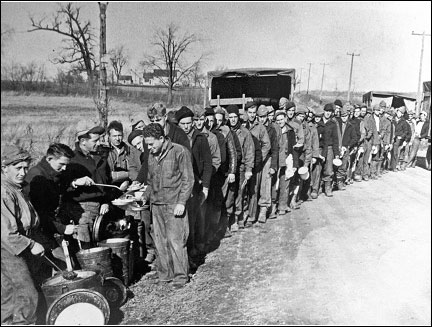
(1)

The Failure to “Trickle Down” 

Source of Image: https://tricountynews.mn/2016/07/14/ccc-helped-millions-of-unemployed-in-great-depression/ 12/10/19

Now here’s an expert with a point actually worth checking out:

(2) The Great Depression in the United States, far from being a sign of the inherent instability of the private enterprise system, is a testament to how much harm can be done by mistakes on the part of a few men when they wield vast power over the monetary system of the country.

Milton Friedman

Source: https://www.azquotes.com/quotes/topics/private-enterprise.html 12/10/19

Two World Wars

World War I

Here’s some startling, misguided expert advice from a vanished past.

Why should we not form a secret society with but one object, the furtherance of the British Empire and the bringing of the whole world under British rule, for the recovery of the United States, for making the Anglo Saxon race but one Empire? What a dream, but yet it is probable; it is possible. 

Cecil Rhodes

Source: https://www.brainyquote.com/topics/british-empire-quotes 11/10/19

And here’s an admission that might surprise you. The spirit of its times?

I think a curse should rest on me — because I love this war. I know it’s smashing and shattering the lives of thousands every moment — and yet — I can’t help it — I enjoy every second of it.

Winston Churchill, a letter to a friend (1916).

World War II

Now the following is among history’s most famous (or infamous) pieces of wrong expert advice.

My good friends, for the second time in our history, a British Prime Minister has returned from Germany bringing peace with honour. 

I believe it is peace for our time… Go home and get a nice quiet sleep.

Neville Chamberlain, British Prime Minister, 30 September 1938.

Source: https://eudocs.lib.byu.edu/index.php/Neville_Chamberlain%27s_%22Peace_For_Our_Time%22_speech 11/10/19

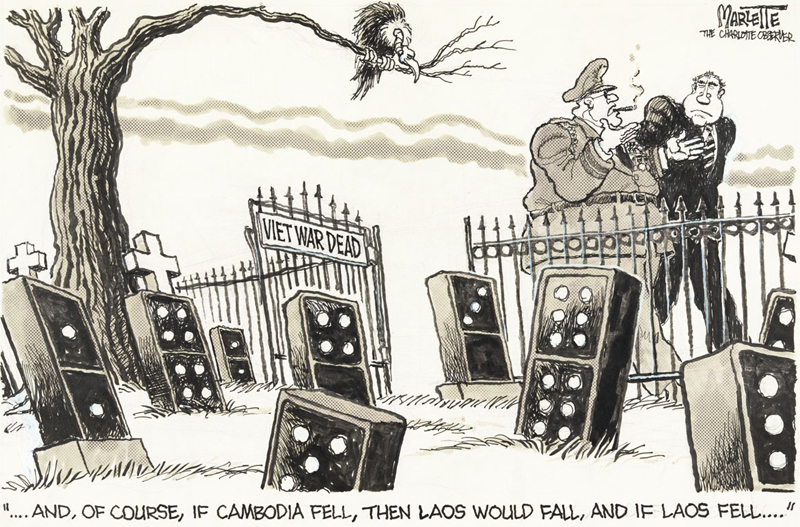
The Vietnam War 1965-1975

Two Expert Opinions Giving Rise To Conflict

 (1)

Source: Creative Commons: https://www.awesomestories.com/images/user/c0110706d589f929da4dc9fd5a2e49eb.jpg 12/10/19

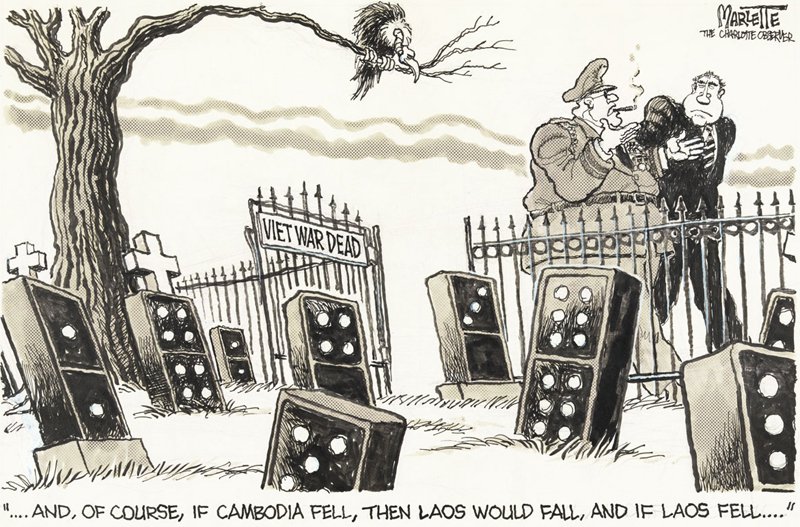
(2)

Source: Creative Commons: https://66.media.tumblr.com/tumblr_m0z1wymbsa1rrgzb0o1_400.png 12/10/19

The expert artists above sum up the propaganda of the time pretty well. The excuse for war wrought havoc in many lives. And it didn’t stop unwilling conscripts fighting a different kind of battle. More trouble for innocents.

The Vietnam Outcome:

We lost the war! Mind you, you don’t find winners of wars, only who’s left.

Here’s a harsh reality

Estimates of casualties of the Vietnam War vary widely. Estimates include both civilian and military deaths in North and South Vietnam, Laos, and Cambodia.

VIETNAM WAR…Total Number of Deaths

Allied military deaths 282,000

NVA/VC military deaths 444,000

Civilian deaths (North and South Vietnam) 627,000

Total deaths 1,353,000

Source: https://en.wikipedia.org/wiki/Vietnam_War_casualties 12/10/19

As for the trauma of the war’s surviving soldiers, and the shattered lives of napalm victims, I’ll let you visit the archives of Hell for yourself.

The Cold War

Now here’s an interesting description of how Cold War experts misled us.

Origins

Brinkmanship is the ostensible escalation of threats to achieve one’s aims. The word was probably coined by Adlai Stevenson in his criticism of the philosophy described as “going to the brink” in an interview with Secretary of State John Foster Dulles under the Eisenhower administration, during the Cold War. In an article written in Life Magazine, John Foster Dulles then defined his policy of brinkmanship as “The ability to get to the verge without getting into the war is the necessary art.” During the Cold War, this was used as a policy by the United States to coerce the Soviet Union into backing down militarily. Eventually, the threats involved might become so huge as to be unmanageable at which point both sides are likely to back down. This was the case during the Cold War; the escalation of threats of nuclear war, if carried out, are likely to lead to mutually assured destruction.

Credible Threats

For brinkmanship to be effective, the sides continuously escalate their threats and actions. However, a threat is ineffective unless credible—at some point, an aggressive party may have to prove its commitment to action.

The chance of things sliding out of control is often used in itself as a tool of brinkmanship, because it can provide credibility to an otherwise incredible threat. The Cuban Missile Crisis presents an example in which opposing leaders, namely U.S. president John F. Kennedy and Russian Leader Nikita Khrushchev, continually issued warnings, with increasing force, about impending nuclear exchanges, without necessarily validating their statements. Pioneering game theorist Thomas Schelling called this “the threat that leaves something to chance.”

Now some details of the consequences:

(1) Brinkmanship was an effective tactic during the cold war because neither side of a conflict could contemplate mutual assured destruction in a nuclear war, acting as a nuclear deterrence for both the side threatening to pose damage and the country on the ‘receiving end’. Ultimately, it worsened the relationship between the USSR and the US.

Source: https://en.wikipedia.org/wiki/Brinkmanship 12/10/19

Now some more details of Cold War mind play. More consequences.

(2) After World War II, the consequences of the Soviet Union’s victory over the Nazis were rejected, and a global containment of communism was elevated into a doctrine by President Truman. By the Cold War, we spurred the Soviet Union from exhaustion to great-power status, the atomic bomb, and space achievement. Our policies against communism in China had much the same effect there. The Cold War has also frozen the world into its immediate postwar postures and prevented peace settlements in East and West. Since 1945 the United States has spent enough resources on the Cold War to make many ailing societies healthy, resulting in a dangerous weakening of our economy. We ourselves have submitted to the militarism we fought in two world wars and have gone far to create a United States dominated by the military. We have depleted our resources for peacetime living, while our competitors have forged ahead with such technologies. We have sadly neglected the nation’s poor, and the President’s Great Society legislation, aimed at helping them, is suffering because of the expense of the war in Vietnam. By making anticommunism our life motive, we have fostered rightist fanaticism. We have forgotten the inexorable law of life that every social system is in constant evolution, and, now that the Cold War with the Soviet Union has eased, we are preparing to wage one against Communist China. Is it too late for us to welcome China to the community of nations, avoid the final world war, and try to organise the unity of man?

Source: https://journals.sagepub.com/doi/abs/10.1177/000271626636600115?journalCode=anna 12/10/19

Note Well This Guardian Spirit Of The Cold War!

In order to bring a nation to support the burdens of maintaining great military establishments, it is necessary to create an emotional state akin to war psychology. There must be the portrayal of an external menace. This involves the development to a high degree of the nation-hero, nation-villain ideology and the arousing of the population to a sense of sacrifice. Once these exist, we have gone a long way on the path to war.

This confession of John Foster Dulles, the fanatical exponent of combative social values, turned even the air we breathed into a substance of violence and hate.

Source: https://quotes.thefamouspeople.com/john-foster-dulles-1907.php 13/10/19

The Iraq War of 2003 et seq.

Yet another double-crosser of the truth came forth in this year.

Colin Powell February 5, 2003.

My colleagues, every statement I make today is backed up by sources, solid sources. These are not assertions. What we’re giving you are facts and conclusions based on solid intelligence…

…My second purpose today is to provide you with additional information, to share with you what the United States knows about Iraq’s weapons of mass destruction as well as Iraq’s involvement in terrorism, which is also the subject of resolution 1441 and other earlier resolutions.

I might add at this point that we are providing all relevant information we can to the inspection teams for them to do their work.

The material I will present to you comes from a variety of sources. Some are U.S. sources. And some are those of other countries.

Some of the sources are technical, such as intercepted telephone conversations and photos taken by satellites. Other sources are people who have risked their lives to let the world know what Saddam Hussein is really up to.

I cannot tell you everything that we know. But what I can share with you, when combined with what all of us have learned over the years, is deeply troubling.

What you will see is an accumulation of facts and disturbing patterns of behaviour. The facts on Iraqis’ behaviour –  Iraq’s behaviour demonstrate that Saddam Hussein and his regime have made no effort  –  no effort  –  to disarm as required by the international community. Indeed, the facts and Iraq’s behaviour show that Saddam Hussein and his regime are concealing their efforts to produce more weapons of mass destruction.

Source: https://www.theguardian.com/world/2003/feb/05/iraq.usa 12/10/19

Now look what GW and his experts did for us.

It’s been 16 years since President George W. Bush ordered the invasion of Iraq. That’s when the American people were told that Iraq had weapons of mass destruction (false); that U.S. troops would be greeted as liberators (false); and that overthrowing Iraqi dictator Saddam Hussein would bring democracy to Iraq and security for the United States (both debatable).

Here’s what the United States has accomplished: As of the end of February, the number of Iraqi civilian deaths sits at 202,757. More than 2.7 million have been displaced internally (2.42 million, down from a peak of 6 million) and externally (280,014). American troop casualties rest at 4,540, and with over 1.5 million U.S. servicemen and women cycling through Iraq, we’re looking at costs — human and financial — that Americans will have to bear for generations to come, with over a trillion dollars being added to U.S. debt…

…The wars against Iraq (and Afghanistan) have been paid for by raising the national deficit, so the United States has put off actually paying for these wars for nearly two decades (the United States invaded Afghanistan in 2001)…

…But veterans themselves are paying a heavy price now, with injuries (including traumatic head injuries), PTSD, depression, and high suicide rates.

Source: https://thinkprogress.org/iraq-war-15-year-anniversary-ac6c5461c69e/ 12/10/19

As to war crimes, the deliberate massacre of civilians, why does this kind of behaviour pass without notice? Do you remember the London Blitz? Dresden? The burning of Tokyo? The burning of Vietnam?

All forgotten? When will we ever learn? One solution cries out from the wilderness of anguish:

Source: http://www.coalitionfortheicc.org

Global Warming

One more example wants to roll off my pen. Here is yet another notable self proclaimed expert’s opinion.

In a letter to Pope Francis, Christopher Monckton, Third Viscount Monckton of Brenchely, wrote 

I have listened carefully, and I can inform Your Holiness that science is divided on the climate question. A small number of totalitarian profiteers of doom in various self-serving national academies have issued pompous statements about it, but a large number of papers from reputable scientists, and a larger amount of hard data, suggest that global warming is and will continue to be a non-event. (June 19, 2019)

Source: https://www.desmogblog.com/christopher-monckton 12/10/19

The above distinguished viscount was welcomed by some in my country at times of hearty debate.

One final folly beckons. This time we go to the top.

First the virtue:

CLIMATE ACTION SUMMIT, 23 SEPTEMBER 2019: Climate change is the defining issue of our time and now is the defining moment to do something about it. There is still time to tackle climate change, but it will require an unprecedented effort from all sectors of society. To boost ambition and accelerate actions to implement the Paris Agreement on Climate Change, UN Secretary-General António Guterres is asking leaders, from government, business and civil society, to come to the 2019 Climate Action Summit on 23 September with plans to address the global climate emergency. The Summit will spark the transformation that is urgently needed and propel action that will benefit everyone.

Next the imprudence:

Australia’s Prime Minister, visiting the United States at the time, did not attend this Climate Action Summit.

____________________________________________

End Thoughts

Now if the false expert is infra dig, to whom can we turn when we need advice? When we need a plan that will work? Who is the true expert.

The answer is the follower of scientific method.

Why is this so?

Well the scientist knows he (or she  ✓) is fallible. Scientific method constantly checks findings and lives by logical argument based on verifiable evidence. The scientist accepts peer group sharing and peer group criticism. The scientist publishes all methods used so that others can repeat the research in question. The scientist holds all beliefs tentatively and stands ready to modify or abandon according to the results of the latest experiment or observation. The scientist, working within rigorous probability, is a thinking reed facing up to and surviving in a hostile universe. His or her findings deserve our attention.

So climate change IS a threat to all life, to everything we love on earth...

royciebaby

A Little Book Of Monsters

Dear Reader

An election is approaching its voting day in Australia as I write. It has inspired me to make a little chapbook. If you would like to find a little more on chapbooks you can do so here.

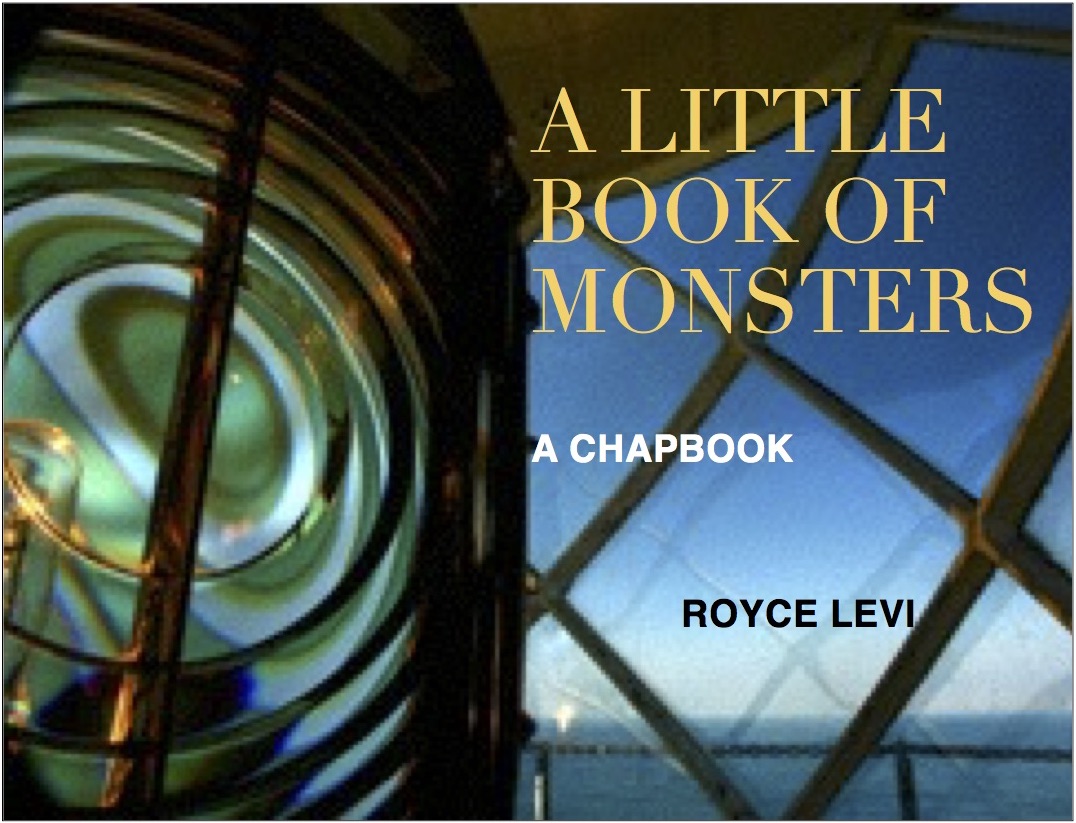
The title of my chapbook is A Little Book Of Monsters and the monsters in my imagination are politicians. I am going to post the pages below. I have designed a cover. Here it is and here are the pages of my little book.

My Chapbook Cover

So there you are. Just a little bit of fun. Thank you for coming to this place and for reading down to here. Recovering from injury so hope to write more frequently. Best wishes, Royce.

On Teaching

Well here I am. Older than most – eighty-five to be specific. For fifty of those years, as a teacher, I helped people fashion their future. Now I’m in my own future, that uncertain time so dependent on whether you can keep on breathing.

What now? Categorised by the powers that be as beyond my use-by date, I often find myself these days like Winnie the Pooh: sometimes I sits and thinks, and sometimes I just sits.

As for the thinking part, I thought I might today share here my thoughts about the classroom as a place of learning. Why not? It’s such an important place. The real nucleus of education. That class at work is close to the only setting where you can truly judge a teacher. Validly and reliably that is.

It is where essential learning journeys begin; where the young bird flies for the first time; where words become wheels in motion; where the penny drops and the mind comes to life.

So here I stand. The following are my ideas gathered through time about teaching behaviour. Do what you like with them.

We first need to answer important questions before we start teaching. What is a classroom? What is a class?

Every classroom is an infinite cauldron of competing forces. Every class is a bubbling pot of individual differences close to boiling point on the day you take over. So when you begin you need to say to yourself, “This is serious. Learn to teach or else!” You might also be aware of the old axiom: “To teach is to learn something twice.”

Jean-Jacques Rousseau, in his Emile or On Education, has an interesting general principle to start you off:

I have already said your child must not get what he asks, but what he needs; he must never act from obedience, but from necessity.

Interesting. Those “needs” are the key. Should they be elitist ideology or genuine universal requirements. Your immediate task ontaking over? To determine, as best you can, the precise, true needs of each child in your care.

Testing therefore will be important. Real teachers, as opposed to upwardly mobile politicians, know the difference between a diagnostic test and an attainments test, and use them both well, certainly not to create league tables and myths of superiority. So the initial teaching time, say the first six weeks, can include something like this:

Initial Attainments TestInitial Diagnostic Test

TEACH

Retest AttainmentsRetest Diagnostic

RE-TEACH ∞

It’s all basic logic. You need first, as the great educational drama guru Brian Way once said, “to find where the child is at.” You can then apply teaching that is appropriate to age, social status, home background, pupil mental and physical health, past achievements, gender, student ambition, available resources and the teacher’s professional awareness. Yes. The role of the teacher is extremely complex.

Testing will always be a part of that complexity. To be avoided at all costs however is a system of public ranking that in itself becomes the main focus of learning. Have you noticed the huge market for so called test panaceas? Worried about NAPLAN? We can fix it. Do these things and win.

Once you have established how close to the chronological age the mental age is, for each student in your care, you are ready to begin your vital work. If you are an infants or primary teacher, you are a generalist and your assessments and diagnoses will be many and varied. You will have developed your own, professional variety of tests. I have found the “getting to know you” short essay from each pupil a very good starting point. It can reveal many things including information from the Affective and Psycho-motor Domains.

I want to talk now about some of my classrooms. The memories remain.That is how I will share my visions of virtue and folly.

My First Class.Class 4B Boys Primary January 1953 45 Pupils: Sydney, Australia.

I was with those boys for a whole year – day after day after day. Each of those days began with a hymn: “Now Thank We All Our God,” and a creed: “I honour my God, I serve my Queen, I salute the Flag.” That routine and comparative order usually moved quickly into chaos. To create a learning climate in such a big class was a challenge for pupils and teacher.

I had so much to learn about classroom management. I would shout above noise, demanding silence. I would bang my desk with a large piece of wood for the same reason. I would blame and punish far more frequently than I would reward virtue. I would delay feedback with written tasks because of the large number of children in my care. It was a hard way to begin my fifty years of teaching.

Abilities in the group were so mixed too. Some were quite bright and many were well below the norms for Year 4. Average age was about ten yet there were two twelve-year-old strugglers who could not read. You had to program, teach and test a plethora of subjects: craft, English, music, maths, science, history and geography, physical education. The inspectorial system was used then. Once a year for the three years of your probation, you were visited by a learned inspector who watched you work and judged your worth as a teacher. At the end of the third year I passed and was awarded a teacher certificate. Such a challenge with but two years teacher training. If I were to begin teaching that class today, their lives would be so much better.

In A One-teacher School. Classes K-6 plus 2 Correspondence; Girls and Boys Primary 1958 19 Pupils: Hunter Valley, New South Wales, Australia.

Here the social role of the teacher was important. It was an isolated community and the teacher was a star of recognised social status. Links with parents were vital as was an awareness of pupil home duties on the farms. Life had taught the older pupils very valuable sibling management skills that were used by the teacher with a number of learning tasks, coping with the age and subject variety – all in one room. ABC radio broadcasts for music and social studies gave valuable assistance. We did lots of story telling for the whole group. Drama also worked well across the grades. Henny Penny for example:

One day an apple fell and hit Henny Penny on the head.

HENNY PENNY: The sky is falling. I must go and tell the Queen. Henny Penny met Goosy Poosy.
HENNY PENNY: The sky is falling. I must go and tell the Queen. GOOSY POOSY: I’ll come wiv ya.

Participation was the aim, not necessarily perfection. Which brings me to a major issue with the contemporary child.

The cyber age has drastically reduced interaction between people in real world contact situations, free of computerised devices. A serious consequence of this is a lack of practice with vital communication skills. I mean gesture, eye contact, the smile and other facial expressions, posture changes linked to meaning – they all tend to disappear in the cocoon of chat group or the SMS. Even Skype is artificial and not the same as a meeting between people without artificial links.

I believe with all my heart therefore, in the vast and present need for drama in classrooms. I mean Theatre in Education (TIE), educational drama, readers theatre and children’s theatre – all required now with constant use.

Another Primary Class After Several Years Of Teaching.Class 6A Girls and Boys Primary 1961 32 Pupils: Maitland, New South Wales, Australia.

A lovely classroom climate. Pupils working busily all the time. No shouting and banging of my desk. A gentle pause instead when necessary, waiting for silence. Important instructions were often given in a soft voice. Listening thus became a reward and helped each good listener’s progress. The effect on classroom climate was important.

One of the pupils from that class recently visited this web page and linked up with me. It was a joy and an honour to meet her. Where does a teacher’s influence end? One of the boys I taught in 1953 also found me in the same way. He was a successful sportsman and teacher. It was also an honour to share coffee and memories with him until he passed away two years ago.

A GA (General Activities) Class.This is a special category of students with limited ability in high schools, staffed by primary trained teachers. My class: boys Median Age 12-14.11 1963 17 Pupils: Sydney, Australia.

The curriculum for this group was focused on everyday survival skills. Teaching time was all-day not 40 minute periods, and in a single room. This was my entry into secondary teaching. I was studying part-time for an Arts Degree so later taught English and history in that and other high schools, and later became an English/History Master. My GA lesson notes:

Spelling: Danger, Poison, Beware of the Dog, Keep Off, Give Way, Wrong Way, Go Back, Halt, Trespassers Prosecuted, Wait Here, Do Not Touch, Electricity, Police, Ambulance, Hospital, Emergency.

Mathematics: Addition of Shopping Bills, Distance Measuring, Easy Fractions, The Four Processes: × ÷ + −.

Social Learning: Electoral Rolls, Emergency Behaviour 000, Police Functions, Interpreting Advertising, Our History and Geography, The Rules Of Good Manners, Job Seeking.

There was a fundamental need for these young people lingering at school until the leaving age of 15. It was self respect. A major strategy required was to give them support to live their debased lives. One of them said early in my time with them, “Gee Sir, you can’t be very bright having to teach us dumb ones.”

We were friends, those seventeen lads and I, and found ways of succeeding with practical things. I met one in the street after he had left the class. He was very excited and wanted to share with me the news that he had found a job with a panel beater.

Is it not an essential duty of all educators to strive to avoid isolation, despair and varying degrees of self contempt in the young? That is a call to arms for us all.

HSC High School English Class. This was a final year class with students from several cultural backgrounds. Year 12 Mixed Gender 1997 27 Pupils, Sydney, Australia.

One of my students, a young man from this class, one day gave me a poem after a lesson. It was a very good poem, hand written. So good I asked him where he found it.

“I wrote it Sir,” he said.
I heard his words with genuine surprise.
“It’s a very moving poem,” I said. “Tell me about it.”

“Well Sir, I am a Kurd. I have lived if four countries counting this one. It makes me very sad because I have not felt that any one of these places is my home.”

There he was, as I observed, a young eighteen-year-old refugee, sharing his anguish with me as a friend. I wondered what my country had done to him to make him feel so much an alien. My humble contribution was to offer support and give him more power to analyse and write in English.

Year 10 History. This was a class with students from several cultural backgrounds. Year 10 Mixed gender 1997 30 Pupils: Sydney, Australia.

My subject one day with this class was the outbreak of World War I. The specific topic was the assassination of the Archduke Ferdinand by Gavrilo Princip. Part of my tale of the assassination ran thus:

The motorcade mistakenly turned into a side street where Princip happened to be hiding. The first three cars began to reverse to the main road giving Princip a chance to fire two shots at the archduke from point-blank range. Within minutes the Archduke and his wife Sophie were dead. Three weeks too young for the death penalty, the Serbian Black Hand member Princip was sentenced to 20 years gaol. He died in that gaol of tuberculosis in April 1918 aged a mere 23.

A day or two after that lesson I was approached by one of my pupils.

“Sir, I’m having a hard time after that lesson about the assassination of the Archduke. Some of the class are bullying me because I’m a Serb and they say I caused World War I.”

This was a shock to me. Suddenly I had to look at my history narrative from a different point of view.

It had been so easy up to that moment to classify “goodies and baddies” in clinical categories. Now one of my pupils was actually threatened by my black and white tale.

I told the troubled lad always to walk away from unfair criticism with head held high. He was not guilty o anything.

“Every nation has a dark side to its history,” I said. ”Austria-Hungary and the Bosnian Serbs had been in dangerous conflict for some time. But don’t waste your time fighting back with events for the bullies to be ashamed of. Just walk away. Learn more history and you’ll find no nation is totally free of shame. Yes. Walk away and learn more. That is your best defence.”

University Class: MA In International Relations (1 Semester 1993) . This was a public-speaking course for diplomats. There were 21 students from many nations.

The teaching strategy here was to immerse the students in great speeches and give them practice through group work largely, in analysing the material for emphasis, pauses, suitable high and low volume, varied speed, connotations, gesture suitability, appropriate posture and valid core themes. Discussion and debate were important aspects of the teaching.

Among the texts were Martin Luther King’s “I Have a Dream” speech, Hamlet’s soliloquy, Mark Anthony’s speech on Caesar, 1 Corinthians 13, and texts contributed by the students. Interaction and peer support were noticeably a feature of this teaching program, in short “learning by doing” as drama pundits tend to say.

University Equity Program.This was a Federal Labor Government funded one-semester equity course I taught at university for non-matriculated applicants seeking entry to university. The literacy section included definition, comparison and contrast, description, scientific discourse, valid argumentation, public speaking and exam technique.

Nine Intakes, 20-30 Students, 1989-1995 a University In NSW, Australia.

The core of this program was an awareness of the power of analytical writing. Students were required to write one essay a week throughout the semester. The result was 10 essays of 250 words, based upon university model questions, all with feedback within one week. Exceeding the word limit was heavily penalised, as was failure to keep to the set question. Students learnt to get to the point quickly and keep to it without padding or irrelevancies.

I taught the nine generations of this program whose graduates achieved higher results in First Year than any other identifiable undergraduate group. Graduates later included a University Medalist in Psychology, several PhDs and many honours degrees across all faculties. Such is the power of precise, analytical writing and supportive, rigorous, ongoing guidance.

As a teacher, I can say my life intertwined with many of
these lives. One example is a single mother beset with a husband failing with alimony payments. She wanted to get into university and become a lawyer. That dream of hers came true, as did the dreams of many other such students.

My Last School.A High School In Western Sydney, Australia

When I retired from university teaching, I worked in this high school from 1996 to 2004. This poem reflects on some of the outcomes.

Vive l’école

A school is not an inanimate thing.

I found this out today

When I visited a place

Where in my yesterdays I used to teach.

‘Hello Sir’ came the voices,

And their looks of recognition

Seemed to tap me

On the shoulder

As I walked across that playground

At recess time

Into the hollow hallways

Where I heard again the footsteps

Of the past

And in its briefly empty classrooms

I met the echoes of my words

And the reflected sounds of yesterday’s pupils

With their sighs of learning struggle

Their misdemeanours

And their Ahas! of the once in a while

When insight sets in.

It was a weird experience this…

A haunted house without ghosts

Not spooks

But thoughts and words

And struggles and despair and hope

And growth and disobedience

And little triumphs over learning curves

And breakthroughs to understanding

And punishment and distraction

And anger and hatred and inspiration

And penalty and injustice and impossible tasks

And, when the last bell rang,

Memories of transformations that never end.

A school is not an inanimate thing.
 

  November 2004

Note: For images, my thanks to Creative Commons.

Memories Of A Second Class Cricketer

A Good Innings

 III

“Look after that shine please!”

John Blomley, Brilliant Swing Bowler

imagesAttribution: Wiki Commons

I have explained earlier, in my personal cricket narrative, that in 1958 I gave up my sporting ambition and returned to teaching. My appointment at a one-teacher school in the outer reaches of the Hunter Valley, with week-day accommodation only, meant that I spent my weekends closer to the city of Newcastle. So how could I not play cricket again?

The 1960 green field I had the good fortune to return to was situated at Stockton, on the north side of the Hunter River. It was a joyous return to the welcoming friendships and support I found there in that club that was a vibrant part of the Newcastle competition. I hope my surviving team mates and all families will forgive me if I focus just on one team-mate. After all these years I realise more strongly that ever what a brilliant human being he was.

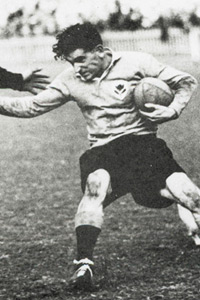
My motive therefore is to make this little piece of mine an obituary in effect to a special friend, John Blomley. Off the cricket field when I knew him, John was a doctor serving the Stockton community in particular. On the playing field he was a star. That star shone not only on the cricket field. As a medical student he had been a fine Rugby Union centre-three quarter with Sydney University, New South Wales and Australia.

Here is a little more on the football side of things:

Born 7 March 1927 at Tumbarumba in New South Wales, Blomley attended St Joseph’s College, Sydney where he came under the watchful eye of the famous rugby coach, Brother Henry. Here, the young Blomley learned the rudiments of the game. Brother Henry insisted on a solid foundation for the young footballer. “There is no room in a college fifteen for a boy whose hands are not safe,” he counselled. “All the footballers at the college must learn the rudiments of the game.”

So Brother Henry turned out Jack Blomley as a polished inside back. After leaving St Joseph’s College in 1944, Blomley entered Sydney University to study medicine and naturally played for Sydney University in the metropolitan competition.

… Although he declared himself unavailable for the Australian Universities tour of New Zealand early in the year, Blomley looked forward to the 1949 representative season with the Maori side touring Australia for a Test series to be followed by a Wallaby tour of New Zealand. Blomley won selection in the New South Wales team that met the Maoris in the third match of their tour. The visitors produced a strong forward display to win 19-14, but Blomley did enough to be selected to play for Australia in the first Test match at the Sydney Cricket Ground.

(Source: Loc.cit. the link below)

Here is an image of John at the height of his Football power. He was known as Jack in his Rugby days.

blomley-john

  Attribution: Loc. cit. the link below

You can read more on the Rugby career of John here at this Rugby site.

Returning to matters of cricket, I can say with some confidence that wicket keepers tend to judge bowlers’ ability accurately. The bowler has a huge hand in the making of the ‘keeper’s status. Part of my destiny was to keep wickets to the bowling of John Blomley.

Now although I was a mere second class cricketer, I have been lucky enough to keep wickets to a number of Australia’s Test bowlers including Johnny Martin, Pat Crawford, Grahame Corling, John Watkins and (as a Golden Oldie) Robert Holland. I have batted against Gordon Rorke, David Sincock and Peter Philpott, all Test bowlers. You can add to that perspective keeping wickets for countless other bowlers from inter-varsity and the Grades of Sydney and Newcastle, as well as the brilliant Merv Black at Arundel for the Australian Old Collegians. Nowhere in that conglomeration of experience can a find another John Blomley.

I am not saying he was the best in my experience. But he was up there, unrecognised largely, with the stars. He was unforgettable with his wit and boundless energy. How sad for him to die aged 43.

John loved every moment of his cricket. His enthusiasm was catching. He polished that ball, especially at Stockton’s oval, like the finest medieval craftsman at work. If you bounced that ball with a throw, you were doomed to hear a torrent of abuse.

He rode the mystic winds of Stockton Bight with that ball like Pegasus. Perfect control with windy support. Three outswingers and then a sudden inswinger at LBW time. A sudden slow ball for a caught and bowled. A faster one, the wicket broken and a bail harmlessly hitting my jaw.

John was a busy doctor too. More than once play was interrupted by the urgent needs of a patient.

He was patient with me too, amidst all of his quest to overthrow batsmen. Cheerful with mistakes and generous with success. I still replay a missed stumping that would have given him a hat trick. It was a legside inswinger that left the batsman and me stranded and resulted in four byes. I have replayed that moment so many times that I am sure I could catch it now, old as I am.

It is such a long time now since I marvelled at John Blomley. We all fade away eventually don’t we? All that is left of our dreams is a memory in the minds of others. But somehow that is a very important place to be.

R

Tea Break From The Cricket

Poems Through A Glass Starkly

News

  A Word On The Yellow Press

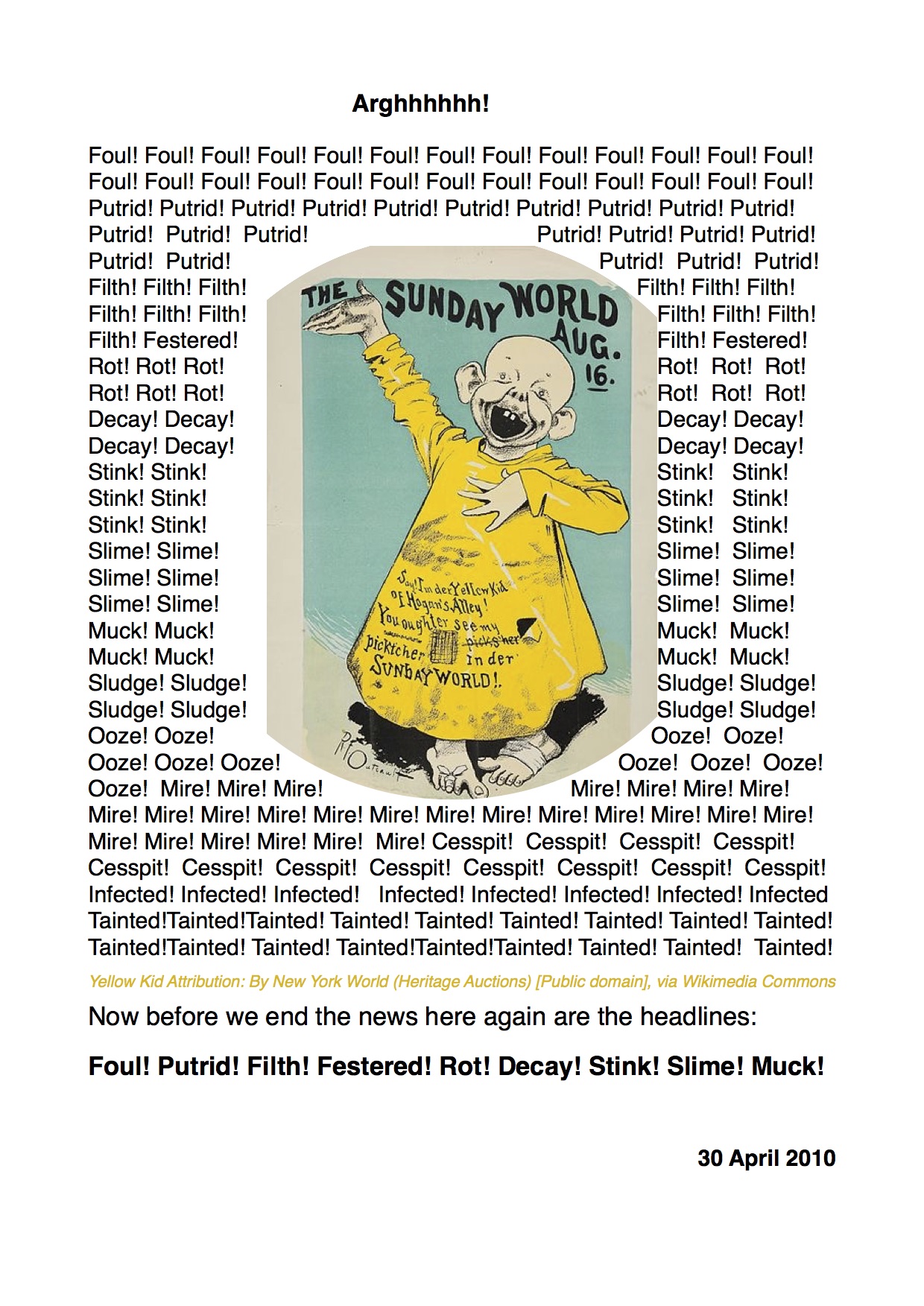
That picture above of the Yellow Kid is linked to the reason we have the current term “Yellow Press.” The cartoon character was the creation of Richard Fenton Outcault who was working in the 1890s in the United States for the extremely racist media mogul Joseph Pulitzer and his New York World. Outcault with his narrative cartoon style is generally regarded as the beginner of newspaper comics.

The Kid was an overtly shallow and uneducated character and spoke in a kind of  uneducated and “immigrant” language. One key aim: denigration. Pulitzer would have been pleased with the colour yellow as he had an intense hatred of Chinese, especially the mid-nineteenth century gold seekers. The head of the Kid was shaved, a common sight in that age of head lice, and he wore a nightshirt that was an inheritance from a sister and on which were written strange, attention getting statements that many thousands of readers took delight in.

Now the story of the Yellow Kid or, to give him his appointed name Mickey Dugan, has a quite startling relevance to our contemporary lives. His adventures were set in a New York Slum – Hogan’s Alley – in a time of widespread poverty and vast social and racial tension. These exploits captured the interest of a multitude. Newspapers largely without real news suddenly were beginning to make a profit – a big profit. Two pennies bought Mickey; to Hell with thinking about worldly matters!

The Yellow Kid was very significantly a distraction from vital news. He sold newspapers and helped change Pulitzer’s insignificant rag into a goldmine of 300,000 circulation. Arm in arm with rape and murder and scandal and war the Kid helped set a news-media pattern that still exists all around us today. The task for Pulitzer and Hearst was not to educate with true, important information but rather to present news selectively and fill the gaps with non sequiturs. That meant attract attention in your market in any way you can.

So today, when chosen samples of worthless and sensational trivialities seize our time and create a vast ignorance of reality, the  name”Yellow Press” is relevant. Mickey Dugan and his world live on.

Randolf Hearst saw the yellow light and stole Outcault from Pulitzer with a higher salary. The Yellow Kid remained the property of Pulitzer (verified by court decision) but another colour achieved similar objectives. But the diversion from reality continued. Other distractions like Buster Brown flourished.

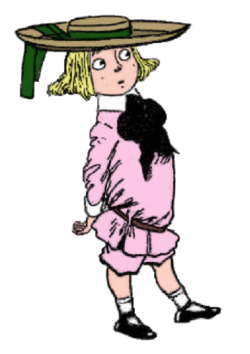
Here is Buster.Buster_Brown_alone_mod_color-1

Attribution: Publisher: New York Herald. Date: May 4, 1902. Artist: Richard F. Outcault.

In contrast to the Yellow Kid, Buster Brown was good looking. Buster Keaton at the time was a child actor so the name was popular. The character was drawn first for Pulitzer but when Outcault transferred to Hearst the character went too as another circulation booster for Pulitzer’s former protege and then his rival. Buster appeared for both magnates but a court decision forbade the use of the name by Hearst. Hearst created many more circulation boosting comic figures. Let us not be too hard on the comics as a distraction. They often entertain after all. It’s non stop murder, rape, scandal and violence including war subject matter that need a line to be drawn. The saddest line of all is always a Siegfried line. What have the media done recently to stop wars?

_________________________________________

An Examination of Testing 

It’s testing time in the madhouse

As the beasties seek to see

If the alphas, gammas or deltas

Deserve a right to be

But the testers have delusions

That illusions must be inclusions

So that all they ever find at best

Is who can do their test

No data on morality in this ordeal hiatus

Just an empty number that proclaims your evil status

Sweet alpha we cannot kiss today for I’m an epsilon

I failed their test and can you guess I am now fit to be spat upon?

So all we humble guinea pigs must make a contribution

While flaws and lies imposed on us have a normal distribution

Someone should write a poem now to expose this dark stupidity

Reliable yes to sort the sheep but what about the validity?

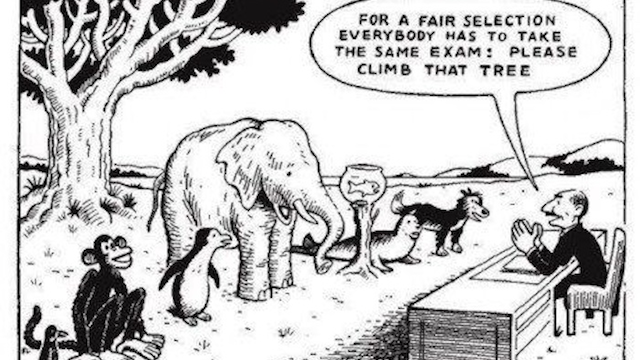
Attribution. Cartoon Source: http://www.thelandscapeoflearning.com/2012/09/please-climb-that-tree.html Date of Visit: 16 October, 2017

_________________________________________


 Ad Ventures In The Gloom

Whoops we diddle and take ‘em down

Fiddle the riddle and kindle the middle

Bash the rash and fake the cash

All for the sake of a sale O

Beguile the smile and sell off the Nile

Export the nought to feed the rort

Flog the log till we’re all agog

All for the sake of a sale O

Enchant the egg to fall off the wall

Invent a rent for the incident

Conjure the wise to standardise

All for the sake of a sale O

Walk like a noodle to feed the fake

Peddle a medal to market the rash

Rat the fink so the price will sink

All for the sake of a sale O

Hoodwink the horde but smile the while

Hoax the folks and delude the fool

Inveigle the bagel to feed the greed

All for the sake of a sale O

Outwit the weather and say it’s fine

Pull a fast one on the last one

Cock-a-doodle let us canoodle

All for the sake of a sale O

17 October 2017

images

Attribution: Source Creative Commons; precise origin unknown.

a150_a4

Attribution: Source Creative Commons. Link: https://unclestinky.wordpress.com/category/pop-culture-stench/page/2/ Date: 17/8/2017

After the break, more cricket.

R.

Memories of a Second Class Cricketer

A Good Innings

II 

One of the most captivating aspects of the Victorian age was its tendency to confuse issues which ought not to have any logical connection at all. Among these the concept of the Gentleman loomed like a cloud over the landscape, permeating every backwater of social intercourse, tilting the balance of debate.

Benny Green A History of  Cricket  Barrie and Jenkins, London, 1988, p. 125.

The theme of this second part of my cricket tales is overwhelmingly ‘my gentlemen.’ It had nothing to do with class or with a capital ‘g.’ The only social status they had was to be in the same place as I was for a serious cricket match. Many of them are no longer alive yet I feel so fortunate they are still with me in my mind.

My performance for Combined Country in February 1957 led to my selection in the Petersham-Marrickville First Grade Team. Our home ground was Petersham Oval. I love that ground.

It was our school home ground for Fort Street and we won the Sydney High Schools competition in 1949. Our opening bowler at the time was Alan Wyatt who went on to open the bowling for New South Wales. I gained selection in the Combined Sydney High Schools team as an opening batsman. I had not taken up wicket keeping at this stage.

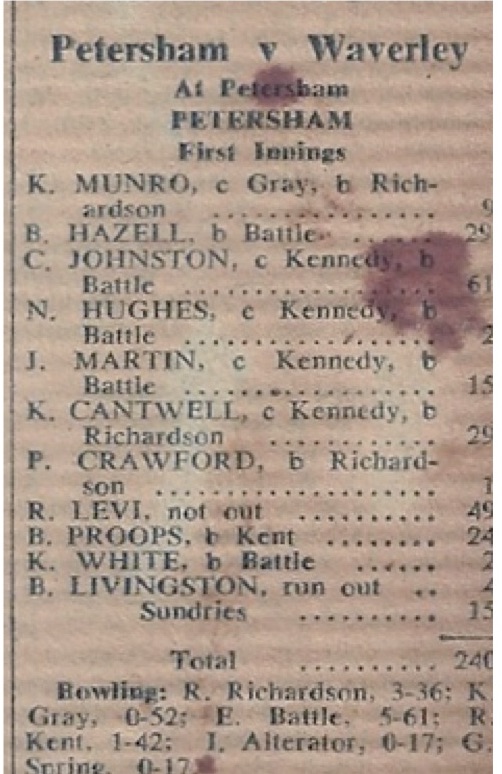
Here is our Petersham Marrickville team in 1957 as revealed by an ancient press clipping. These people are some of my ‘gentlemen’ but as you can see, the newspaper decided to give them capital letters.

Petersham

Clive Johnstone was at times captain of New South Wales. Noel Hughes had recently returned from a stint with English cricket. His sons, young at this time, were to grow into a distinguished cricket and football family.

Johnny Martin was yet to be the noted Test player. He was incredibly hard to “read” as a bowler for the wicket keeper that I was. We had an agreement that he would nod for a wrong ’un. Alas his mind and his body were not always in harmony so I would often get the wrong message. Poor batsmen though! He would trick them constantly too. But then I had to stop the ball to prevent four byes.

Johnny Martin was a lovely human being. A man of massive talent with bat and ball. As a first slip player he often stopped byes from a ball I missed. He was a true friend, humble and supportive. I had got to know his two brothers too in earlier days.

Vince was an opening bat for Stockton in the Newcastle competition I later played in. I rode in a taxi, when I was teaching in Maitland, driven by Johnny’s brother Tom. He said to me, “Keep an eye out for that young fellow (brother John). He’ll play for Australia some day.” He was right.

Johnny is also famed for his big hitting on Melbourne Cricket Ground. With ordinary bats too, not the supercharged 20/20 ones of the present.

Kevin Cantwell was a slow medium for whom I stood up to the stumps and got a stumping in one match match against Gordon. He was a brilliant field and a leading baseball player. I remember Brian Taber as the Gordon ‘keeper in that match, before his Test fame had arrived.

Pat Crawford had just returned from bowling for Australia at Lords . He was quick. I had met him in the National Service strangely enough. He represented New Holdsworthy’s troops while I was the wicket keeper-batsman for Old Holdsworthy. Keith Herron, a First Grade wicket-keeper for Drummoyne and a very diminutive person, had to deal with Pat’s bowling on a mat. I remember one of the deliveries almost going for six byes – or more accurately these days six wides.

Pat was kind to me and supportive, a rather overwhelmed country lad that I was. The other three team members were very good bowlers. Bruce Livingstone was the opening bowler for New South Wales, along with Pat Crawford.

Ken White was a skilful off spin bowler. Television came to Australia in 1956. The ABC was televising Grade cricket matches in 1957. In our match at Bankstown Oval, Alan McGilvray and Michael Charlton were busy describing our all-day performances. Ken was bowling to new batsman Grahame Thomas. He moved out to a yorker, missed, the ball hit my ankles and I missed the stumping. Thomas went on to get fifty, play for Australia and have an oval at Bankstown named after him. So as I see it everything happens for the best.

Ron Briggs for Bankstoen had been batting all day before Thomas came in, and finished with 187. Alan McGilvray was very sympathetic for the stressed out keeper with hours in the field who missed that one of so many balls. Had I made that stumping perhaps there would be an oval named after me instead of Grahame. (Only joking,) Just a few mistakes sent me to Second grade and thence back to a lifetime of teaching not cricket.

Combined Country 

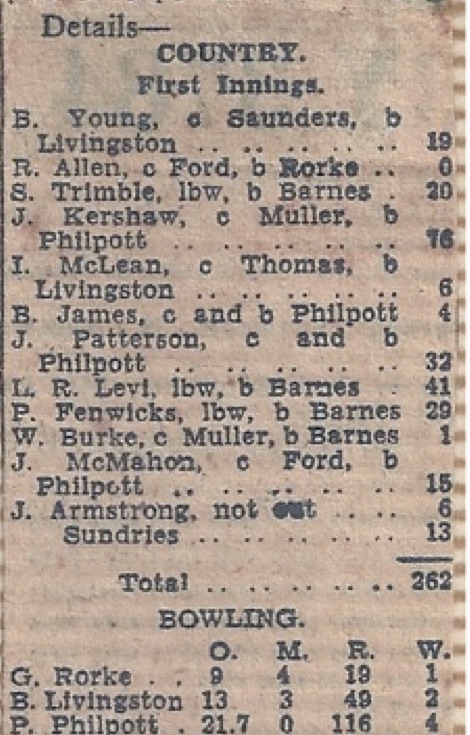
Here is an ancient and  just surviving record of the Country innings on the first day of that match: February 13, 1957.

Petersham.pdf 2

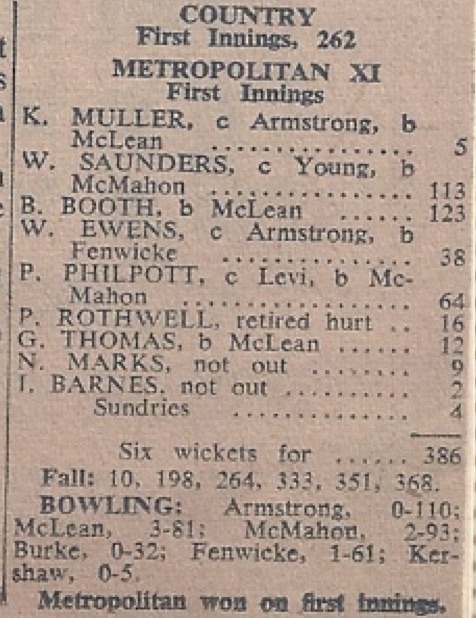
My happiest memories are linked with the human qualities of the players, the gentlemen. First, the chance to talk for an hour after the match with Brian Booth, a captain of Australia, was a delight. A man of great status, he was so humble and so easy to talk to. His words were a fine complement to the artistry of his batting I observed on the field. His opening partner Warren Saunders was also a sheer delight to share time with.

Here is the Sydney innings. It clearly shows the cricket powers of those two players in particular.

Country Inns 1

It was an interesting experience too to be treated by the Cricket Association as representative players. Accommodation in the now extinct Hotel Sydney was very comfortable. Hire car transport to and from the SCG was relaxing for the players. Cricket boots left in the dressing room over night were cleaned with bright whiteness next morning. A small player wage we got to cover costs was quite an honour and a new experience.

Sam Trimble broke a finger facing Gordon Rorke. He was taken away for medical treatment and resumed his innings later. That was the starting moment perhaps of an illustrious career with Queensland and later Australia.

The haloed SCG itself was another joy. That “visitors” dressing room had served many players of distinction. A haloed place to be,

My other Sydney opponents in that match of long ago are still remembered.

Ken Muller I had met in my school days. He was a Fort Street student as I was. Peter Philpott was twelfth man for the 1949 Combined High Schools team I played in. He was a thoughtful bowler who turned the ball quite sharply and deserved more wickets. He was also a stylish batsman. I was destined to play against Grahame Thomas later in the year, as I have discussed elsewhere.

My Second Experience of Sydney Grade  

In the 1957/58 Sydney season I played four matches in First Grade and two in Second Grade. I batted only twice in the four First Grade matches for 20 not out against Gordon, and 49 not out against Waverley. I was not called on to bat against Western Suburbs and Bankstown. In Second Grade I scored 71 against Paddington at Rushcutters Bay and 20 against Glebe-South Sydney at North Sydney Oval. So my batting average was rather good.

After the demotion I felt a stronger calling from the profession I loved — teaching. I decided to leave the city, if the Department of Education so decreed, and rejoin the permanent teaching ranks. I was appointed far from the city cricket scene to a one-teacher school at Chichester via Dungog in the Hunter valley.

At Chichester I was unable to get weekend accommodation so I had to stay with my parents at Ferodale, four miles north of Raymond Terrace.

Thus, with the help of Fate, I was able to return to cricket at Stockton in the Newcastle competition. This in many ways was the beginning of another cricket adventure. The next part of my narrative will focus on this.

To end this chapter, these links might interest you:

(My special thanks to the wonderful Marrickville cricket researchers.)

Marrickville Cricket Club, in my time joined with Petersham, has a long and proud history commencing in 1910.

Notes From The Net and My Memory

As you know, I played with Johnny Martin and Pat Crawford. I admired from outside the fence Barnes , Alley and Moroney. Alley became a test umpire in England and in his very first Test with the very first ball he had to give a decision. It was out, caught behind and he was right. Andrews was before my time.

I saw Jack Moroney when I was an admiring kid, hit a six right over the rail arches in a Grade match at my Glebe home ground, Jubilee Oval. He was a solid Test opener but he could be aggressive too. Two ducks in a match were an inaccurate cause of demotion in that seven Test match career. He was a high school maths teacher by profession.

Marrickville CC’s players include Johnny Martin, Pat Crawford, Sid Barnes, Bill Alley, Jack Moroney and Tommy TJ Andrews  It has been home to Australian Captain Bob Simpson and three of Bradman’s ‘Invincibles’ – Ernie Toshack, Bill Brown and Ron Saggers. I remember the grace of Ron Saggers when he played for New South Wales. To clash in time with Test star Don Tallon from Queensland was bad luck for Saggers.

Here is a link to the Marrickville site:

http://www.marrickville.nsw.cricket.com.au/content.aspx?file=4224%7C23309m&print=1

Leg bye now,

R

Memories of a Second Class Cricketer

A Good Innings

I

Because cricket was for many years my chief escape from what are sometimes  laughingly called serious affairs, I promised myself I would never write about it. This is the seventh book I promised never to write.

Benny Green A History of  Cricket  Barrie and Jenkins, London, 1988.

For my agnostic father Alex, cricket was a religion. Perhaps it was an obsession.

Whatever it was, he bowled countless leg breaks or wrong’uns to my brother Vic and me in our backyards or on holidays wherever we went. That was probably the reason I hit Australian leg-spinner Peter Philpott for four leg-side boundaries on the Sydney Cricket Ground for Combined Country against Sydney in 1957. I don’t wish to imply I was ever a first-class cricketer, so that makes those boundaries an even greater achievement for my Dad.

During our annual visits to Berrara, a camping place of long ago (in the Forties) south of Nowra, off Fisherman’s Rock Road, we took a big spade and made a turf wicket for the “Test” matches that went on through the school holidays. There were plenty of players from the tents around us.

Mum and Dad were parents of the Great Depression and I was born in the alleged winding down year, 1933. Dad made me a billy-cart for Santa one Christmas, and added a cricket bat he also fashioned himself. Lots of cricket bats followed though, real ones, with compound cricket balls (cork not leather)  to play with as times changed for the better.

I remember buying a Stuart Surridge bat from Mick Simmons’ sports store:  George Street, corner with Campbell Street. Simmons made his money first from tobacco and then branched into sporting goods. Creams and shirts were bought there too. I loved going into that shop. Mick also would employ famous sportsmen to serve there, another big attraction for me and many others. Sport was not a corporate business then so the “stars” of the time were probably often glad of that job.

As I write, other sporting stores of my era come to mind. I bought my first wicket-keeping gloves from Bert Oldfield’s store, 243 Pitt Street Sydney. He taught me where to stand behind the stumps, advice I kept for the rest of my wicket-keeping days. A funny anomaly in those first cricket days was the sticky stuff we used to put on wicket-keeping gloves. Now I realise that if you didn’t concentrate, didn’t watch the ball and thus moved too late and snatched, the glue was a waste of time and money.

Yes times did move on as I’ve implied. In that past, you oiled your bat with linseed oil  – quite a test of your loving care. I think I remember rolling it with a broom handle and bouncing cricket balls on the surface to harden it. How different things are now – iron clad surfaces already on some of the bats you buy!

I remember too Stan McCabe’s store. He was a very quiet man who always served you courteously and humbly.  I bought in particular practice cricket balls from him. I was very sad to hear of his untimely death when it happened long ago now. His deeds against bodyline don’t die.

My introduction to Sydney Grade cricket came from Glebe South Sydney. This was because we moved to Newtown. I have learnt that the administrators of the grade competition decided, I think around 1910, that you had to live in the area of the club you played for. That aimed to strengthen the competition and draw crowds. So because I lived in Newtown, off I went to Jubilee Oval Glebe via the Glebe Point tram.

Albert (Tibby) Cotter, Warren Bardsley, Charles Kelleway and Bertie Oldfield all played for Glebe. Cotter, Bardsley and Kelleway also went to Forest Lodge Primary where Bardsley Senior was headmaster for many years, having taught one time in Warren, New South Wales. Oldfield was secretary of the Glebe Club in 1915.

Tibby Cotter was actually killed, in his life’s prime,  at the Battle of Beersheba in October 1917. He chose to join the cavalry charge although not strictly required to do so. As I write, the centenary of that event is being celebrated with full military honours. We can actually join the celebration of this and other fatal events for a deposit of $500 AU and then further payments. Death and destruction have strange bedfellows these days.

We young Glebe players were cared for paternally by a small group of senior players. I remember especially Jim Bowden, the First Grade keeper and later a Sheffield Shield umpire. A lucky friend for me. There was practice at the nets and there were practice matches mixing the grades on the main oval.

It was a great inspiration for us lower grade players to practice with the seniors. Ron Kissell, a state player, was there. He played eleven first class matches for New South Wales between 1946 and 1952. Bobby Madden was also there, an opening batsman briefly for New South Wales and a soccer player for Australia. I remember when he was dismissed for 99 for the state. 

One of the umpires in those practice matches was George Borwick, an umpire in the Bodyline series. Mrs Borwick made and served, with other ladies, afternoon tea for us. That was the kind of community we had then and will always need.

Mr Borwick was an influence on me. I remember a durable piece of advice: “If you think you are not out, look in the scorebook.” That has stabilised me many times since.

I was chosen in the club’s Green Shield (under 15) team as a leg spinner. I remember in a match at Waitara Oval that the fence was far to close for my bowling..

I made it into Fourth Grade as a batsman however, and so began a beautiful friendship. Then a wicket-keeper was needed so I volunteered. The friendship blossomed. Jim Bowden was a great help to me down a few years.

Those years passed and I worked my way up into Second Grade. Never to First Grade with that club.

Then came the family move to Ferodale, four miles north of Raymond Terrace on the Pacific Highway. In his usual way, Dad fostered my cricket interests as well as all the others. In conversation with Doug Rawlings, the manager of a shoe-store in Raymond Terrace, Dad found a link with Northern Districts Cricket Club in Maitland.

Another beautiful friendship began there, both with Doug and family and with cricket. Maitland has a special place in my life. I met my wife there much later. The cricket too is a lasting memory.

I remember Doug Rawlings, a memorable man who drove me up from Raymond Terrace each Saturday, and often rolled the wicket before a match. Col Johnstone, a State second eleven player, was our captain and my mentor. Our opening bowler’s name was indeed Mudd. The other opener was Keith Smith – a source of inspiration too as he had lost an arm in a factory accident. He batted quite well and bowled very well. He got a hat-trick against a visiting Sydney team (Western Suburbs). There, with those true friends, I studied the game further.

Inter-district cricket was one of the joys of that time. I met Doug Walters then, a while before his fame. He was a Dungog lad. I noticed the strength of his forearms.

The inter-district cricket led to selection in the Combined Country team of 1957.

Combined Country Selection

It all happened because I had resigned from teaching for a year to play cricket. First came the selection trial match at Tamworth. I survived that. On next to another match in Armidale. I survived that. Finally on to Grafton Oval. No mistakes there either, and I remember taking a diving catch out near square leg. That may have helped me gain selection in the final team.

At this time of writing I interpose a momentary reflection on Robert Holland. “Dutchy” has just passed away. Fate has been kind to me as I had the honour of playing Golden Oldies cricket with him in Vancouver and in Queensland.

A most inspiring person. Kind, humble and gifted in sport. I was present at the Sydney Cricket Ground when he took ten wickets against the West Indies when they were at the height of their power. I lost my voice for a week or so from cheering. I remember his Lords achievement of many wickets too.

Another kindness of fate was my sitting next to him in an Air New Zealand plane en route to Vancouver for twenty-odd hours. There was so much to share on that lucky journey. He told me of his talk with Bill O’Reilly when he Robert was chosen for Australia. O’Reilly told him the bowler was captain when the bowler bowled.

When he went to England, Robert saw fit to talk to the great English leg break bowler Douglas VP Wright, whom I saw dismiss Don Bradman with a lifting “leggie”  at the SCG just after the war. Wright apparently took eleven hat-tricks in his cricket lifetime. The advice from the Englishman, who by the way had a long run up and spread his arms like wings just before his last stride of the delivery, was to bowl the third ball of the hat-trick fast and on the stumps.

“Dutchie” was a gentle man; he was humble and not intent on winning above all else. I am so lucky to have known him and he gave me a stumping in one of his Golden Oldies overs. I am sad he has gone but memory eases the pain a little.

Now back to my narrative… (I will go on writing from here soon.)

Au revoir to the reader,

Royce

Gateway

My Time With Gateway

This is a little story about a university group. It is a tale of adversity, determination and, in many cases, ultimate triumph. The students who joined that group had experienced life the hard way. Some had been floored by drugs, there were several divorcees with children, one candidate had MS and used to talk to me each week about how his friends were getting weaker and sometimes dying; I have a beautiful painted shell given to me by one of several indigenous members of the group, and there was a blind student who typed her answers deliberately without using brail.

Gateway was a program, funded by the Federal Labor government in 1989, at the University of Wollongong. It was a spin off from the similarly funded “New Start” program, which my colleagues and I ran at UWS, two years before, with promising success.

This so-called equity scheme was a one-semester course for non-matriculated students to give them a chance to enter university. There was an English component, a mathematics component, and introductions to various aspects of university life, such as the library and the student union.

I am not a mathematician so my information on that is zero, except to say that the staff member was a revered member of the Mathematics Teachers’ Association, had both feet on the ground, and was a highly experienced university teacher.

As for English, we taught them that when you speak, you write on air, but when you write for formal occasions such as essays or examinations, it stays there for everyone to see and judge. We focused on the university essay and ways to make it good. We discussed especially the power of the sentence as a package of meaning; faulty package: damaged meaning.

We explained that every essay, whether it is an assignment or an exam question, ALWAYS has two components: the topic words, which tell you what to write about, and the directives, that tell you how to write about it. So, for Compare and contrast Sydney and Melbourne as modern cities, the topic words are Sydney and Melbourne, and the directive is compare and contrast as modern cities. To succeed here, you must talk about both cities; you must both compare and contrast them and not merely describe them; you must also discuss them as modern cities, not (necessarily) as football teams.

There is another essential. To do well you must have worked hard and know a lot about the two cities. The point though was that a fountain of knowledge sabotaged by irrelevance or incompleteness leads to at least disappointment, if not failure. Naturally spelling, grammar, style and narrative structure were among the outcomes of the weekly marking and post mortem discussions.

Can you decrypt this code I filled their first essays with: KTTQ?

It was Keep To The Question. Failure here still is a common weakness.

Candidates were given a 250-word essay to write each week. It was marked and returned to them in the next lesson a week away. There was always a post mortem session on strengths and weaknesses before the next lesson started. Words in excess of 250 were penalised. Too many, and the essay was marked but with a zero score. They were all informed of Blaise Pascal et al.’s famous words: “I am sorry I have not time to write you a short letter; I have to write you a long one.”

We worked through some of the commonest university tasks: description, analysis by resolution of controversy, analysis through definition or clarification, analysis through interpretation, the writing of technical reports and individual creative responses. We learnt the best way: with quick feedback from our mistakes. Everyone had to give a speech before the class group (a terrifying task for some) and we nurtured each other through that and every other ordeal. It was good for me as the teacher too. To teach is to learn something twice. Notice I prefer the word “teach” to “lecture.”

Now I want to talk about a few people I remember specially. No names, as we have such respect for each other, and they seem to be sitting beside me now, although it is part of two decades ago.

In one of the night classes, a man and a woman were sitting at the back of the room. I said to the class, “I might bring my ‘thesises’ next week to show you.” Within about two minutes, both of them were standing up waving their dictionaries at me. “You should have said “theses.”

I was a student of Professor Wilkes, at Sydney University. He had spent much of his life getting rid of Latin and Greek endings in English. I brought them my Collins Dictionary, which Professor Wilkes edited, and there was my version too. But I agreed with them that their version was easier to say.

The male student is a lawyer now. During his Law studies, he became World Champion Client Interviewer. It was a very big contest, run for law students around the world. He won the final in Scotland. The woman who waved the dictionary was an expectant mother. The baby joined us about a week after the Gateway course finished, and I had the delight of giving a present to a beautiful baby girl. Her mother was a brilliant student, went on to an honours degree and a position at the university.

On another occasion, I was spoken to on the telephone by the daughter of a potential student, who was seeking admission to the program for her mother. It turned out that both the mother and father were involved in a bus disaster some time previously in Queensland. Both were unconscious for a long time and both eventually survived. Recovering, they returned to Wollongong and were getting on with their usual life when the father dropped dead at the family home. The daughters wanted a remedy for the empty sadness.

We admitted the mother to the course. I could hear the screams of joy from her daughters in the background when I rang to tell them. That student walked with the aid of a walking stick. I remember her delightful, meticulous, small handwriting, and her willingness to discard her former ways and try something new. One of the first things I had said to each beginning class was “Warning! Warning! This course is dangerous to your preconceptions.”

The vision I remember most, however, of that particular brave person is her long walk to the stage on Graduation night, without her walking stick, in a beautiful, sparkling, black dress that contrasted with her neatly arranged, white hair. She entered university and studied with one of her daughters.

On another memorable occasion we had a call from the Secretary of the Steelers Rugby League Club, seeking a place for one of his young players. I was impressed by the caring attitude of that League official and his concern for the player’s welfare. The young man was qualified to enter the course, so in he came. He did the course, but was a star second-rower in First Grade for many seasons, with no time for university. Perhaps he could have used his entry qualifications later in life.

I remember too, a brave and diligent divorced mother with children who was badly treated by a recalcitrant ex-spouse. She dreamed of becoming a family lawyer. She became one.

We had a very popular leader of a musical group, suddenly dreaming of becoming an academic. Through Gateway, he gained university entry and an Honours degree in Creative Arts. He went on to his PhD thesis. Alas! When he passed away two years ago, I lost a true friend.

I am not sure I can explain the success of this group. In the six years I taught in the program, I could feel a sense of their bonding, their support for each other in a common cause. It is something that is hard for teachers to create, and even harder to define.

The Gateway group was the most successful of any identifiable undergraduate group in the University. Changes came, with lack of funding from the Federal Government, but I was gone then and the struggle belonged to somebody else. Sadly that gateway is now closed.

I still have a message from one of the women in the very first Gateway class, on a card given to me on my retirement from the University. It says, “Royce I will never forget you.” She had won the University Medal for Psychology.

Somehow, when I think of all my failures, of all the things I wish I had done better, people like these tap me on the shoulder and say, “Never mind; you did your best.”

So here I am in the wasteland of advanced maturity. Can you imagine how I feel, with my background, when I see the barriers to university study placed on students today. Wherever I go – OfficeWorks, Woolworths and Coles checkouts and elsewhere – I wish young people good luck with their studies and with their HECS payment. Almost always they smile back and thank me.

I have three degrees, each taking six years of part-time study. Because of the whims of time I have not paid one cent of HECS.  In fact the Department of Education of New South Wales actually paid for my first degree’s university tuition.  Such a golden age that was. Somebody then understood that the thousands of pupils in my 50 years of teaching would all fill workplaces and pay taxes. Lord what fools these present day political mortals be!

And what bigger fools vote for them!

Afterthought

If you have failed in one of those diabolical, terminal, one-off qualifying tests and still want to go to university, don’t give up. Go for it as a provisionally matriculated student. You’ll have experience on your side. R.

Nostalgia

Good morning

Illness and life-struggle have kept me away from this place for a while. I am glad to be back. It seems sometimes almost a duty to keep on sharing.

When you are old, above the average life span, it is hard not to think of the past. Old friends who seemed eternal pieces of the establishment are no longer with you. They keep tapping you on the shoulder and softly saying, “Should auld acquaintance be forgot?”

There is “Abba” for instance, an old mate from the distant past to the almost present.  A fellow teacher he was, like me destined for New South Wales classrooms. A shearer’s son whose courage, determination and acquired wisdom made him eventually the principal of a big Sydney high school. We shared “National Service” (Conscription) too, in 1951. The light of his laughter in later times still lingers. We claimed to have prevented a bigger war at the time. No conflict would have been feasible with soldiers of our ineptitude.

There is Nanny too, my Grandfather, who enlisted in the Eighth Division at the age of 60 (declared age 45) and was captured by the Japanese at Singapore. He taught me to count in Japanese when he came back, weighing six stone seven, in 1945, after helping to build the infamous Burma Railway.

And George, a recent demise. Another teaching colleague. I need advice of his no- nonsense kind, and I long for his companionship today. A life-member teacher unionist and primary school principal, George still reaches out to me with an awareness of so many things I could have done better in my early life.

So there they are – old friends. Let them be for now. Let them rest with Don Bradman and Pete Seeger and Humphrey Bogart and Richie Benaud and all the others. They’ll be back whenever a thought demands it.

Other memories are here now. Age gives you a big data base of recollections. In the Thirties and Forties you were a child of the British Empire. In cinemas you stood up before the feature film, for the national anthem. It was “God Save The King” until February 1952. In those young days you loved the  “cracker night” of every Empire Day. Catherine wheels and double-bungers and throw-downs and rockets and the big bonfire made childhood gloriously exciting. You learnt in Fifth and Sixth Class (primary school) that all the red countries in your atlas were part of the “Empire on which the sun never sets.” Nothing to do with communism.

Memories now of that BIG war. From 1939 to 1945 Russians were “goodies.” You liked them and you hated Hitler and Tojo, drawing spiteful pictures of the “baddies,” sometimes on your desk. During that war life was threatening. Even though you were merely a child, the memories remain strong.

The gun flashes out to sea off Cronulla were like sheet lightning. The city of Sydney seemed to have lost all its lights. Cars had funny metal things over their headlights with just a small slit for the light to come out. Some had big boxes on their roofs burning stuff as substitute for petrol. Food and clothing were rationed, as was petrol. During a film at a “picture show” you were asked to buy War Bonds to help beat the enemy. You were also warned that the enemy was listening behind walls so you mustn’t speak about war secrets. Chewing gum disappeared in those war years. It must have been reserved for soldiers and other war personnel.

All the railway stations had their names taken down. There were steel piles on the beaches to stop invasion forces. Fighter pilots were heroes and you could see them training overhead.

I knew their names as later I knew sporting names: “Paddy” Finucane, “Bluey Truscott, Clive “Killer” Caldwell … I loved watching the Hurricanes skimming the waters of Yowie Bay and the rest of Port Hacking. As a non-war excitement, I was also enchanted by the Tiger Moths that stalled and spun far up in the sky over the Port Hacking/Sutherland area where my first home was. Those non-war pilots were adventurers too. You don’t see arial games any more like those ones. The sky is needed by the commercial aircraft companies, the air force and the police. No one flies under the Harbour Bridge now either.

Back to the war. The searchlights practising at night and piercing the World War II sky are also unforgettable recollections. Anti-aircraft practice was noisy, but no enemy ever bombed lucky Sydney. Perhaps that is one reason we participated willingly in later wars.

I remember too, aeroplanes towing practice targets a considerable distance behind them on a long lead. The pilots of the planes doing the towing now seem to me very brave in their fearless disregard of the possibility of friendly fire disaster.

My parents’ newspapers provided other entertainment for us “kids”. There were “Bluey and Curley” exploits of mischievous soldiers, “Boofhead” tales of the funny idiot, “Ginger Megs” who was one of us, “Saltbush Bill” on Eric Jolliffe’s farm, my hero Buck Rogers who foretold the future, “Dick Tracy,” Brick Bradford and “Prince Valiant”. Then there was The Phantom or Ghost Who Walks, who left the imprint of a skull on your jaw when he knocked you out. You could buy the skull ring for your own pretended belligerence. Best friend of all for me was Mandrake the Magician, who gestured hypnotically in Mum’s Women’s Weekly that came out every month.

The modern wonder of the cyber world might give you a chance to share my remembered comic fun here.

Cinema serials were full of excitement too. “The Green Hornet,” and  “Roy Rogers”  have never left my memory.

There was no television in my childhood. The radio was king. I used to sit up close to the set to listen to “The Search For The Golden Boomerang.” Tuckonie the youthful indigenous adventurer was my hero. I loved the introductory music too. I think it was “The Dance of the Flutes” from Tchaikovsky’s “Nutcracker Suite”. Fancy a tale of a hero such as Tuckonie in the era of the White Australia Policy! There were other heroes too: First Light Fraser, Biggles (who still makes me sizzle sausages), Hop Harrigan, Superman, Tarzan, The Shadow, The Lone Ranger. “Hagen’s Circus” is also an exciting memory.

As with the “Golden Boomerang” music, the “Dad and Dave” theme is also strong in my memory. It was “Along The Road to Gundagai,” music and Lyrics by Jack O’Hagan. It was played between scenes at different speeds according to the excitement pitch of the moment. It also introduced and ended each episode.

Laughter was easy to get from the radio too. Rex Dawe’s “ Yes What” is forever funny. “Dad and Dave” with Dad’s “starve the lizards Mabel” and Dan Agar’s “Mrs ‘Obbs” still bring me pleasure and I still hear Lou Vernon’s whistling of “Annie Laurie” (I think) as he introduces his serial episodes with, “Hello. Aye it’s me, Doctor Mac.” Mum listened frequently to “Portia Faces Life,” “Martin’s Corner,” “Big Sister” and “When A Girl Marries.” Radio drama has been accurately called “Theatre of the Mind.”

Well there you are. Your past stays a part of you in spite of the intrusions, the retroactive inhibitions psychologists refer to. I could ramble on further about radio because it was embedded so firmly in my childhood mind.

If you would like to learn more about those experiences, you might enjoy a visit to here.

As I said before, the past seems to rear up at you when you get old. I hope my words suggest that it is not always an enemy. “Nostalgia” seems to sum up the situation pretty well: Greek nostos – return home; algos – pain. But what’s in a word? Meaning as well as beauty is often in the eye of the beholder.

Time is so valuable these days. I don’t mean the money-grabbing television time. I mean the real stuff. I’ll end by going back again, just a little way.

joan tree poem

Until next time, soon I hope,

Royce